
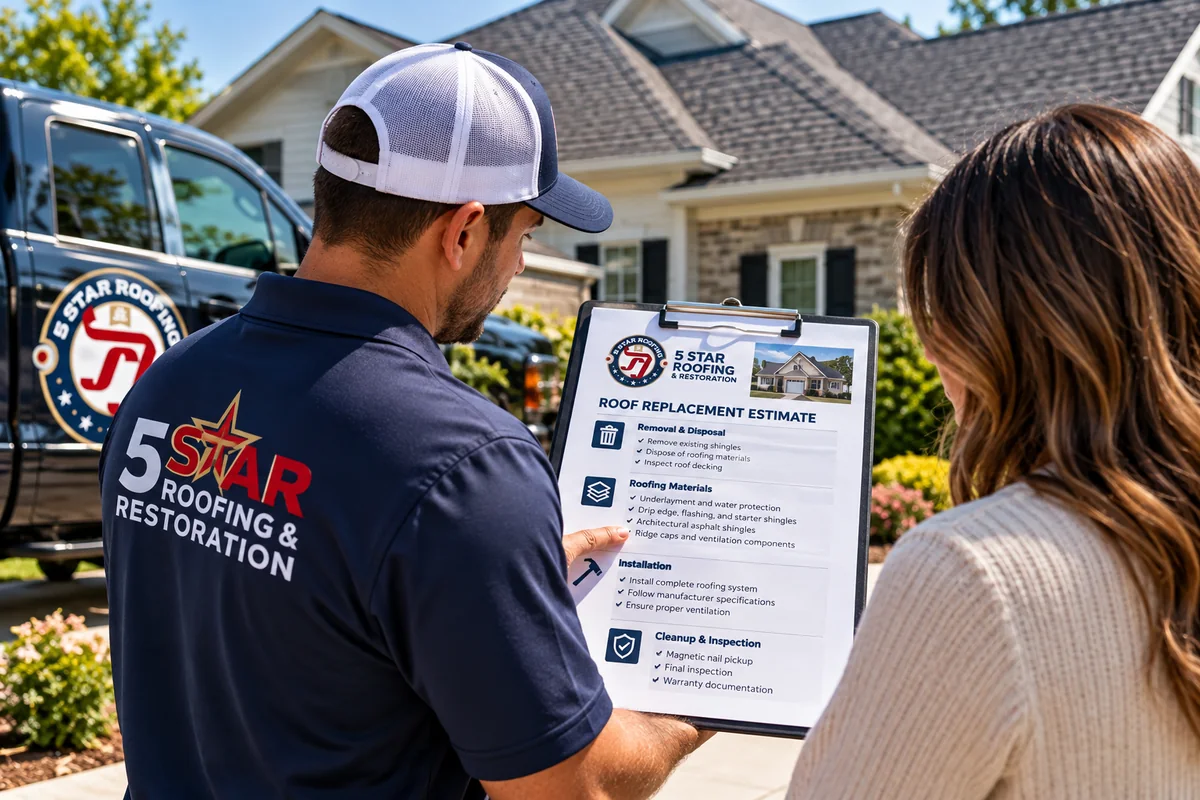
What Is Included in a Roof Replacement Estimate? A Complete Homeowner Guide
Getting a roof replacement estimate is an important step toward protecting your home. But when two roofing contractors provide different prices for what appears to be the same project, how do you know which proposal offers better value?
The answer often comes down to what is actually included in the estimate.
A roofing quote should explain much more than the price of new shingles. It should identify the materials, removal work, installation requirements, potential repairs, warranties, cleanup responsibilities, and payment terms associated with the project.
For homeowners in Greensboro, Winston-Salem, High Point, and surrounding North Carolina communities, understanding these details can help prevent unexpected charges and make it easier to compare roofing contractors.
At 5 Star Roofing & Restoration, our Piedmont Triad roofing services include roof inspections and replacement evaluations to help homeowners understand their roofing options.
This guide explains the essential components of a roof replacement estimate, common exclusions, potential additional charges, and the questions to ask before signing a contract.
Quick Answer: What Should a Roof Replacement Estimate Include?
A comprehensive roof replacement estimate should address these 12 essential items:
- Roof measurements: The estimated roof area, pitch, and project complexity.
- Existing roof removal: What roofing materials will be removed and disposed of.
- Roof decking: Inspection procedures and pricing for any necessary repairs.
- Underlayment: The type of secondary water-protection material.
- Roofing materials: Manufacturer, product, color, and applicable specifications.
- Flashing: Treatment of chimneys, vents, valleys, walls, and other intersections.
- Ventilation: Any included intake or exhaust ventilation work.
- Labor: Installation work and related services.
- Permits and inspections: Who handles applicable requirements.
- Cleanup: Debris removal, nail collection, and property protection.
- Warranties: Manufacturer and workmanship coverage.
- Total price and payment terms: Costs, exclusions, change orders, and payment schedule.
Not every roofing project requires identical work. However, a contractor should explain which items are included, excluded, or dependent on conditions discovered during installation.
1. Roof Measurements and Project Details
A reliable estimate begins with an understanding of your roof's size and design.
Roofing contractors commonly measure roof surface area in squares, with one roofing square equal to 100 square feet.
For example:
- 1,500 square feet of roof area equals 15 roofing squares.
- 2,000 square feet equals 20 roofing squares.
- 2,500 square feet equals 25 roofing squares.
These measurements refer to the roof surface, not the home's interior square footage.
A roofing estimate should account for:
- Roof dimensions.
- Roof pitch.
- Valleys and ridges.
- Dormers.
- Chimneys and skylights.
- Roof penetrations.
- Material waste.
- Accessibility.
A complicated roof may require more labor and materials than a simple roof with a similar surface area.
Homeowner tip: Ask how the contractor measured your roof and whether the proposed quantities account for its actual design.
2. Removal and Disposal of Existing Roofing Materials
One of the first questions to ask is whether the estimate includes removing the existing roof covering.
A complete tear-off generally involves removing the old shingles and applicable roofing materials before installing the replacement system.
The estimate should clarify:
- Whether the existing roof covering will be removed.
- How many layers are included in the removal price.
- Whether disposal fees are included.
- How debris will be collected.
- Whether additional charges apply if multiple layers are discovered.
- How the contractor will protect surrounding property.
What About Installing New Shingles Over Old Shingles?
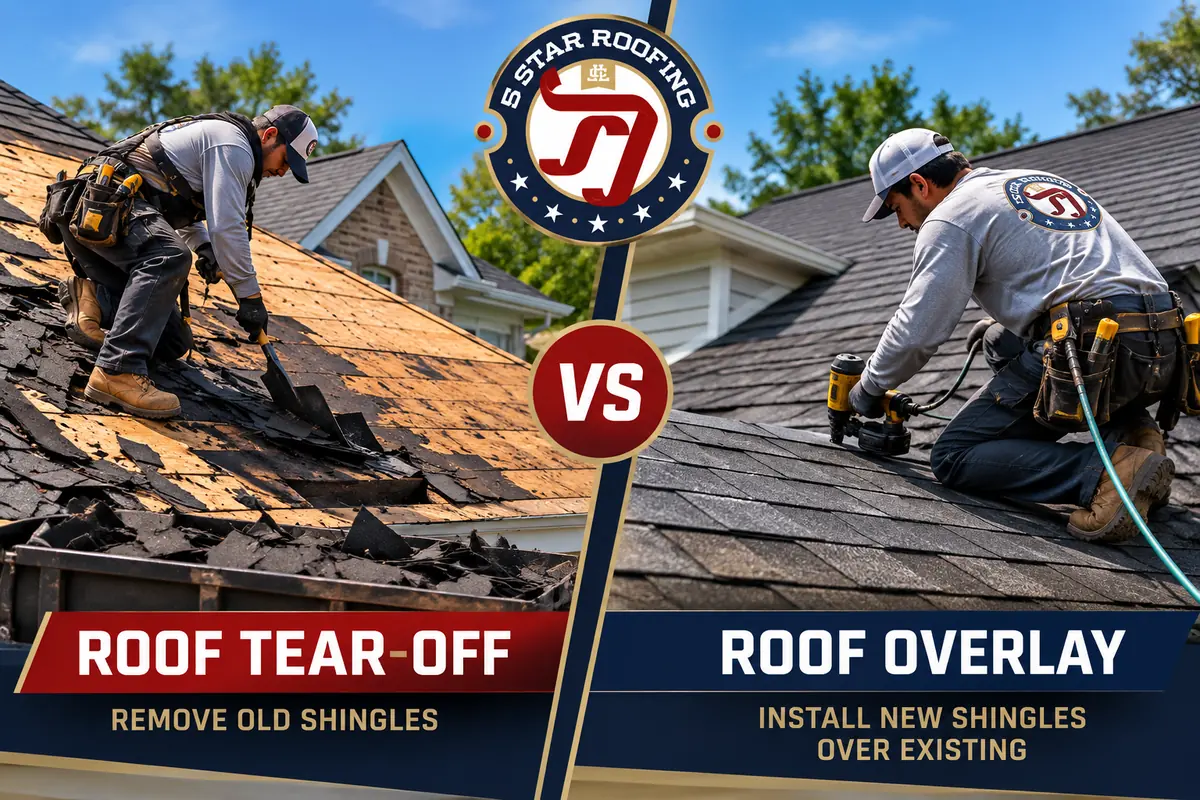
Some contractors may propose an overlay instead of a complete tear-off.
An overlay involves installing another roof covering over an existing one, when permitted by applicable requirements and manufacturer instructions.
Although an overlay may reduce some initial removal expenses, it also leaves much of the underlying roof deck concealed.
Before comparing prices, make sure both contractors are proposing the same type of installation.
Our guide to roof tear-off versus roof overlay explains the trade-offs in greater detail.
3. Roof Deck Inspection and Replacement Allowances
The roof deck is the structural surface beneath the roofing materials.
Common residential decking materials include plywood and oriented strand board, also known as OSB.
Once the old roof covering is removed, the contractor can evaluate the exposed decking.
Potential problems include:
- Water damage.
- Deteriorated wood.
- Loose or unsuitable panels.
- Previous installation defects.
- Damage around roof penetrations.
Is Decking Replacement Included in the Estimate?
This is one of the most important questions homeowners should ask.
Some proposals include a specified allowance for decking repairs. Others charge separately based on the amount of damaged material discovered.
Ask the contractor:
- Is any decking replacement included?
- What is the unit price for additional decking?
- How will damage be documented?
- Will photographs be provided?
- Does additional work require homeowner approval?
- Could decking repairs delay the project?
A clear written procedure for unexpected repairs can help prevent billing disputes.
4. Roof Underlayment and Water-Protection Materials
Underlayment is installed beneath the primary roofing material and provides a secondary layer of protection.
Different products have different specifications and installation requirements.
Common materials include:
- Synthetic underlayment.
- Asphalt-saturated felt.
- Self-adhering water-protection membranes for designated applications.
Your estimate should identify the selected products or clearly describe the system being installed.
Why Does Underlayment Matter?
The visible shingles are only one part of the roofing system.
Underlayment and other water-protection components help manage moisture that may reach beneath the primary roof covering.
Roof valleys, penetrations, and certain edge conditions may require specialized details.
Ask your contractor to explain which materials will be used and where.
5. Shingles or Other Roofing Materials
The estimate should clearly identify the primary roofing material.
For asphalt-shingle projects, look for details such as:
- Manufacturer.
- Product line.
- Shingle type.
- Selected color.
- Starter shingles.
- Ridge caps.
- Applicable system components.
For metal roofing, the proposal should identify the relevant panel system, material, finish, and installation specifications.
Why Is the Exact Product Important?
Two estimates may both say “architectural shingles” while specifying different products or system components.
The price difference may reflect differences in materials, installation requirements, or warranty eligibility.
Ask for the specific product name rather than accepting a vague description.
Are Premium Shingles Worth the Extra Cost?
That depends on your budget, design preferences, and performance requirements.
A higher-priced product is not automatically the best choice for every home.
Compare:
- Product specifications.
- Wind-related ratings and installation requirements.
- Impact-resistance ratings, where applicable.
- Appearance.
- Maintenance expectations.
- Warranty terms.
- Total installed cost.
Your contractor should explain the differences without relying solely on marketing claims.
6. Flashing and Roof Penetration Details
Flashing is an essential part of a roofing system because it helps manage water around roof intersections and openings.
Common flashing locations include:
- Chimneys.
- Skylights.
- Plumbing vents.
- Roof valleys.
- Sidewalls.
- Dormers.
- Roof-to-wall transitions.
Will the Contractor Replace Existing Flashing?
Do not assume that every flashing component will automatically be replaced.
Some details may be reused where appropriate, while others may need replacement or correction.
The estimate should describe the proposed treatment.
If a contractor plans to reuse existing components, ask why they are suitable and whether that approach meets the selected roofing system's requirements.
Important: Improper flashing can contribute to roof leaks even when the shingles themselves are in good condition.
7. Attic Ventilation
Attic ventilation is another detail that homeowners may overlook when comparing roofing estimates.
Depending on the home's design, a roofing project may involve evaluating existing intake and exhaust ventilation.
Common ventilation components include:
- Ridge vents.
- Soffit vents.
- Box vents.
- Other roof ventilation systems.
Not every home needs the same ventilation arrangement.
The appropriate approach depends on the roof assembly, attic configuration, and applicable requirements.
What Should the Estimate Explain?
Ask whether the contractor will:
- Evaluate existing ventilation.
- Retain suitable components.
- Replace damaged components.
- Install new vents.
- Modify existing openings.
- Address identified ventilation deficiencies.
If ventilation work is recommended, ask for an explanation of the proposed changes.
8. Roofing Labor and Installation
A roofing estimate should explain the scope of installation work, even when labor is included in a single project price.
The proposed installation may involve:
- Property preparation.
- Existing roof removal.
- Deck preparation.
- Installation of underlayment.
- Installation of edge components.
- Shingle or panel installation.
- Flashing work.
- Ridge caps.
- Ventilation details.
- Cleanup.
- Final inspection.
Why Do Labor Costs Differ?
Labor requirements can vary because of:
- Roof pitch.
- Roof complexity.
- Material selection.
- Property access.
- Safety requirements.
- Existing roofing layers.
- Necessary repairs.
- Installation specifications.
A steep roof with multiple valleys and penetrations generally requires different work than a simple roof.
Rather than comparing labor costs alone, evaluate whether the estimate includes the complete installation scope.
9. Permits and Required Inspections
Roofing permit requirements depend on the proposed work and the jurisdiction where the property is located.
Requirements may differ for straightforward roof-covering replacement, structural repairs, and changes to the roof assembly.
Before approving the estimate, confirm:
- Whether a permit is required.
- Who will obtain it.
- Whether permit fees are included.
- Who schedules required inspections.
- Who is responsible for project closeout.
What About HOA Approval?
Some homeowners associations have architectural requirements involving roof colors, materials, or appearance.
If your home is part of an HOA, review applicable rules before ordering materials.
A contractor may assist with documentation, but homeowners should confirm who is responsible for obtaining any required association approval.
10. Property Protection and Cleanup
Roof replacement involves debris, equipment, and temporary construction activity around your home.
A detailed estimate should explain what cleanup and property-protection services are included.
Property Protection
Depending on the project, these may include:
- Designated equipment access.
- Debris containers.
- Landscaping protection.
- Protection of vulnerable exterior features.
- Material staging areas.
- Safety restrictions.
Cleanup
The agreed cleanup scope may include:
- Removal of discarded shingles.
- Removal of packaging and excess materials.
- Collection of accessible debris.
- Magnetic nail collection.
- Removal of temporary equipment.
- Final work-area inspection.
Magnetic nail collection helps reduce leftover fasteners, but it cannot guarantee that every nail will be recovered.
Ask about the contractor's procedures and responsibilities.
11. Roofing Warranties
A roofing estimate should identify the warranty coverage associated with the proposed work.
Roofing warranties commonly fall into several categories.
Manufacturer Material Warranty
This generally addresses qualifying defects in roofing products, subject to the manufacturer's terms.
Contractor Workmanship Warranty
This addresses certain installation-related problems under the contractor's written warranty.
Enhanced Roofing System Warranty
Some manufacturers offer enhanced warranty programs for eligible roofing systems installed by qualifying contractors.
These programs may have specific requirements involving:
- Contractor certification.
- Eligible materials.
- Installation procedures.
- Required roofing components.
- Registration.
- Coverage terms and exclusions.
5 Star Roofing & Restoration is a GAF Master Elite® contractor and can explain available GAF roofing system warranty options.
What Should You Ask About Warranty Coverage?
- What warranties are included?
- Who provides each warranty?
- How long does coverage last?
- What is excluded?
- Is registration required?
- Is the warranty transferable?
- How are claims submitted?
- Are additional fees involved?
Ask to review the actual warranty documents before making a decision.
12. Total Price, Payment Terms, and Change Orders
The final estimate should clearly explain the financial terms of the project.
At minimum, homeowners should understand:
- Total proposed price.
- Included work.
- Excluded work.
- Deposit requirements.
- Payment schedule.
- Accepted payment methods.
- Financing terms, if applicable.
- Procedures for additional charges.
- Contract cancellation provisions.
- Any applicable taxes or fees.
What Is a Change Order?
A change order is a documented modification to the original scope of work.
For example, if the contractor discovers damaged decking after removing the old roof covering, additional repairs may be necessary.
The contractor should explain the condition, proposed work, cost, and approval process.
How Can You Reduce Unexpected Charges?
Before signing, ask the contractor to identify potential cost changes.
Common examples include:
- Additional decking replacement.
- Hidden structural damage.
- Multiple roofing layers.
- Unanticipated flashing repairs.
- Additional ventilation work.
- Changes requested by the homeowner.
A transparent estimate should explain how these situations are handled.
Example Roof Replacement Estimate Checklist
Use this checklist when reviewing a roofing proposal.
Estimate componentWhat to verifyContractor informationBusiness name, contact details, insurance informationRoof measurementsRoof area and scopeRemovalExisting layers and disposalDeckingRepair allowances and unit pricingUnderlaymentProduct and installation scopeRoofing materialsManufacturer, product, and colorFlashingReplacement or reuse detailsVentilationExisting and proposed componentsLaborComplete installation scopePermitsResponsibility and feesCleanupDebris removal and nail collectionWarrantiesManufacturer and workmanship coveragePriceTotal cost and exclusionsPaymentDeposit and payment scheduleChange ordersApproval and pricing procedures
Homeowner tip: If a proposal does not address an important item, ask for written clarification before signing.
Why Are Roofing Estimates So Different?
Two contractors may inspect the same house and provide substantially different prices.
That doesn't necessarily mean one estimate is wrong.
The proposals may differ in important ways.
Different Roofing Materials
One contractor may specify a standard architectural shingle while another proposes a premium product.
Different Installation Scopes
One estimate may include a complete tear-off, while another proposes an overlay.
Different Flashing and Ventilation Work
A proposal may include replacing certain components that another contractor plans to retain.
Different Decking Allowances
One contractor may include an allowance for damaged decking, while another prices all decking repairs separately.
Different Warranty Options
Enhanced manufacturer warranty programs may have different requirements and costs.
Different Property Conditions
Contractors may identify different concerns during their assessments.
Ask each contractor to explain the basis for the recommendation.
The lowest estimate isn't necessarily the best value, and the highest estimate isn't automatically the most complete.
How Much Does Roof Replacement Cost in North Carolina?
Roof replacement costs vary significantly with roof size, materials, labor, complexity, and existing conditions.
For preliminary budgeting, some homeowners may consider a broad illustrative range of approximately $8,000–$22,000 for many asphalt-shingle roof replacements, although individual projects can cost less or substantially more.
This is not a verified North Carolina market average or a quote.
For a more detailed discussion, read our 2026 North Carolina roof replacement cost guide.
A property-specific inspection and written proposal are necessary to establish the actual project price.
Roofing Estimates in Greensboro, Winston-Salem, and High Point
The core components of a roof replacement estimate are similar throughout the Piedmont Triad.
However, the property's design, age, condition, access, and applicable local requirements can affect the scope.
Greensboro Roof Replacement Estimates
Greensboro homeowners may have older roofing systems, established residential properties, or newer homes with different roof designs.
A detailed estimate should reflect the property's existing conditions rather than relying solely on its square footage.
Our Greensboro roofing services include roof inspections, repairs, and replacement evaluations.
Winston-Salem Roof Replacement Estimates
Winston-Salem properties can include complex rooflines, older flashing details, and existing roofing materials that require careful evaluation.
Homeowners should ask how potential concealed conditions will be handled during replacement.
Learn more about our Winston-Salem roofing services.
High Point Roof Replacement Estimates
High Point homeowners should compare the materials, removal scope, decking provisions, and warranty coverage included in each proposal.
A clear written estimate makes it easier to evaluate competing bids.
Explore our High Point roofing services for local roof replacement and inspection options.
Surrounding Piedmont Triad Communities
Homeowners in Kernersville, Jamestown, Summerfield, Oak Ridge, and nearby communities should confirm that their contractor serves the property and understands the applicable jurisdictional requirements.
A contractor's service area does not necessarily mean it maintains a physical office in every community.
Red Flags to Watch for in a Roofing Estimate
Be cautious when a contractor provides a proposal that leaves major questions unanswered.
Potential warning signs include:
- No clear description of roofing materials.
- No explanation of whether old shingles will be removed.
- Unclear decking repair pricing.
- Missing flashing details.
- No written warranty information.
- Unspecified cleanup responsibilities.
- Vague payment terms.
- No change-order process.
- Pressure to sign immediately.
- Unwillingness to answer reasonable questions.
A concise estimate can still be legitimate, but the scope and terms should be clear enough for the homeowner to understand the agreement.
Should You Get Multiple Roof Replacement Estimates?
Obtaining multiple estimates can help homeowners understand available options and compare the proposed work.
However, the quotes should be evaluated on a consistent basis.
When comparing estimates:
- Check whether all contractors propose the same removal method.
- Compare roofing product specifications.
- Review underlayment and flashing provisions.
- Confirm decking repair allowances.
- Compare ventilation work.
- Review warranty terms.
- Evaluate cleanup responsibilities.
- Compare payment schedules.
- Ask about exclusions and potential additional charges.
A side-by-side comparison can reveal important differences that are not obvious from the final price.
Frequently Asked Questions About Roof Replacement Estimates
What should a roofing estimate include?
A detailed roofing estimate should address roof measurements, existing roof removal, decking repairs, underlayment, roofing materials, flashing, ventilation, labor, permits where applicable, cleanup, warranties, total price, and payment terms.
Is roof decking replacement included in a standard estimate?
Not always. Some estimates include a decking allowance, while others charge separately for damaged decking discovered during installation. Ask for the pricing and approval procedure in writing.
Should a roof replacement estimate include flashing?
The estimate should explain how existing flashing will be evaluated and whether replacement or other work is included. Do not assume every flashing component will automatically be replaced.
Are permits included in roofing estimates?
Permit responsibilities and fees vary by project and jurisdiction. The proposal should identify who handles any required permits and inspections.
Why is one roofing quote much cheaper than another?
Differences may involve roofing materials, removal methods, flashing work, ventilation, decking allowances, labor, warranties, or other parts of the project scope.
Can a roofing estimate change after work begins?
Yes, if unexpected conditions are discovered or the project scope changes. The contract should explain how additional work is documented, priced, and approved.
Should I pay the full roofing estimate upfront?
Payment practices vary, but homeowners should review the contractor's payment terms carefully and avoid making payments they do not understand. The contract should specify when payments are due and what work or milestones they relate to.
Does a roof replacement estimate include cleanup?
Cleanup is commonly part of a replacement proposal, but the exact responsibilities should be stated. Confirm debris removal, accessible nail collection, and removal of equipment.
Are roofing warranties included in the estimate?
The proposal should identify applicable manufacturer and workmanship warranties. Enhanced warranty options may involve additional eligibility requirements or costs.
Is a free roof estimate the same as a roof inspection?
Not necessarily. An estimate focuses on the proposed work and price, while an inspection evaluates roofing conditions. Ask the contractor what its assessment includes.
Why Choose 5 Star Roofing & Restoration?
5 Star Roofing & Restoration serves homeowners throughout Greensboro, Winston-Salem, High Point, and surrounding Piedmont Triad communities.
As a GAF Master Elite® roofing contractor, our team provides:
- Residential roof inspections.
- Roof repairs.
- Complete roof replacement.
- Asphalt-shingle roofing.
- Metal roofing options.
- Storm-damage assessments.
- Roofing system and warranty guidance.
- Financing information for qualified homeowners.
We understand that a roof replacement is a major investment.
Our goal is to help homeowners understand their roofing options and make informed decisions about the work their homes need.
Request a Roof Replacement Estimate in the Piedmont Triad
A good roofing estimate should give you more than a price. It should help you understand the condition of your roof, the proposed materials, the work involved, and the terms of the project.
If you're planning a roof replacement in Greensboro, Winston-Salem, High Point, or a surrounding community, our team can help you evaluate your roofing needs.
Call 5 Star Roofing & Restoration at (336) 780-7800 to request a roof inspection and replacement estimate.
Disclaimer: Pricing examples and project descriptions in this article are for general educational purposes. Actual roof replacement requirements and costs depend on the property's condition, selected materials, applicable requirements, and written scope of work.
Fill out our quick contact form to get a free estimate from one of our Roofers

Contact us today for a free estimate, and let us show you why we're the preferred choice for homeowners and businesses alike. We're a family-owned local roofing company.
Top Roof Repair & Replacement Greensboro
Whether you're in need of a roof repair, full shingle roof replacement in Greensboro, or a completely new roof in Greensboro NC, our expert team is ready to deliver high-quality results with unmatched professionalism.We also specialize in insurance roof replacement in Greensboro, helping homeowners navigate the claims process after storm or hail damage with ease. If you've experienced wind or storm damage and need roof repair in Greensboro, we’re here to respond quickly and protect your home from further harm.Our services extend beyond traditional repairs to include metal roofing, commercial roofing, and complete residential roofing solutions — ensuring we have the right system for every customer and every roof type.

Metal Roofing
We specialize in installing GAF Timbersteel metal roofs: a stylish and energy efficient choice.

Roof Repair
We repair roof damage and roof leaks, execute roof replacements, and ensure that every square foot of your roof is in top condition.

Roof Replacement
Roof replacement is crucial not just for structural integrity but for a home's overall value.

Roof Inspection
We review both the interior and exterior components of the roof to identify potential issues.

Roof Rejuvenation
We methodically clean all roof types to improve curb appeal and avoid potential issues with this valuable preventative maintenance.

New Roof Installation
We take pride in installing cutting edge, long-lasting, and energy efficient roofs.